
What Is Lost Wax Casting and Why Does It Matter?
Lost wax casting — known in the industry as investment casting — is one of the oldest and most precise methods of creating fine jewelry. Dating back over 5,000 years, this technique remains the gold standard for professional jewelry manufacturing today. Whether you're an independent jewelry designer, a growing retail brand, or a seasoned industry professional, understanding the lost wax casting process can help you make smarter decisions about your production workflow, costs, and design possibilities.
At JewelCAD Design Ltd in Bangkok, we use this time-tested method combined with modern CAD and 3D printing technology to deliver exceptional results for clients worldwide. Here's exactly how it works — step by step.
Step 1: Create the Master Design (CAD Modeling)
Every piece starts as a digital design. Using professional jewelry CAD software, our designers build a precise 3D model of your piece — capturing every prong, curve, and surface detail. This digital file allows for easy revisions before any physical material is committed. If you're bringing your own design, we can work from sketches, photos, or existing CAD files.
Step 2: 3D Print the Wax or Resin Model
Once the CAD file is approved, it's sent to a high-resolution 3D printer that produces a castable wax or resin prototype. This physical model is a near-perfect replica of your final piece. Modern jewelry 3D printing technology means incredibly fine detail — as small as 0.1mm — is reproduced accurately and consistently, making it ideal for intricate designs and gemstone settings.
Step 3: Attach the Model to a Wax Tree
Individual wax models are attached to a central wax rod called a sprue, forming a structure that looks like a tree. Multiple pieces can be cast in a single batch, which significantly improves efficiency and reduces per-unit cost — a major advantage for small brands looking to scale production affordably.
Step 4: Investment (Encasing in Plaster)
The wax tree is placed inside a metal flask and surrounded by a liquid plaster-like material called investment. Once it hardens, the flask contains a perfect negative cavity of every piece on the tree. This is where the magic of the process gets its name — the wax will soon be lost.
Step 5: Burnout — Removing the Wax
The flask is placed in a kiln and heated to temperatures between 700°C and 800°C. The wax melts and burns away completely, leaving behind hollow cavities in the investment material. This stage also cures and strengthens the mold in preparation for molten metal.
Step 6: Casting the Metal
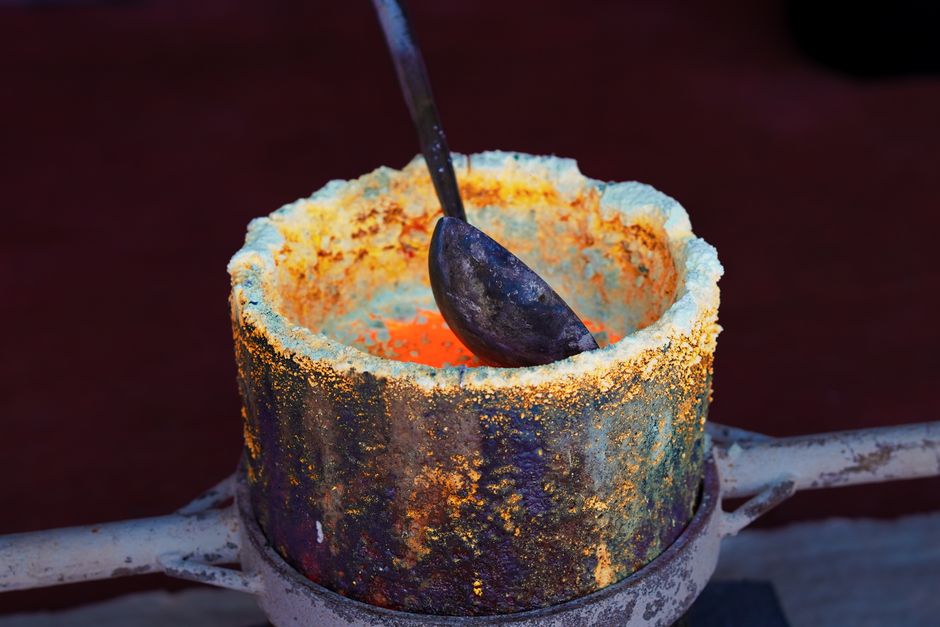
Molten metal — whether sterling silver, 18k gold, platinum, or brass — is forced into the empty cavities under vacuum or centrifugal pressure. The metal fills every detail of the mold perfectly. This is where your design transforms from concept into reality in precious metal.
Step 7: Breaking Out and Cleaning
Once the metal cools, the investment is broken away, revealing the metal tree. Individual pieces are cut from the sprue, then go through cleaning, polishing, and finishing processes. At this stage, gemstones are set and final quality checks are completed.
Why Lost Wax Casting Is Ideal for Custom Jewelry Production
- Exceptional detail reproduction — captures fine textures and complex geometries
- Scalable production — cast multiple pieces per flask for better pricing
- Works with all precious metals — gold, silver, platinum, palladium, and more
- CAD-compatible — integrates seamlessly with modern digital design workflows
- Consistent results — ideal for production runs requiring identical pieces
"Understanding the casting process helps designers create pieces that are not only beautiful but actually manufacturable — saving time, money, and frustration."
Ready to Bring Your Design to Life?
Whether you're launching a new jewelry collection or need a reliable manufacturing partner in Bangkok for ongoing production, JewelCAD Design Ltd offers end-to-end services — from CAD design and 3D printing through to casting, setting, and polishing. Contact our team today to discuss your project and receive a free quote.